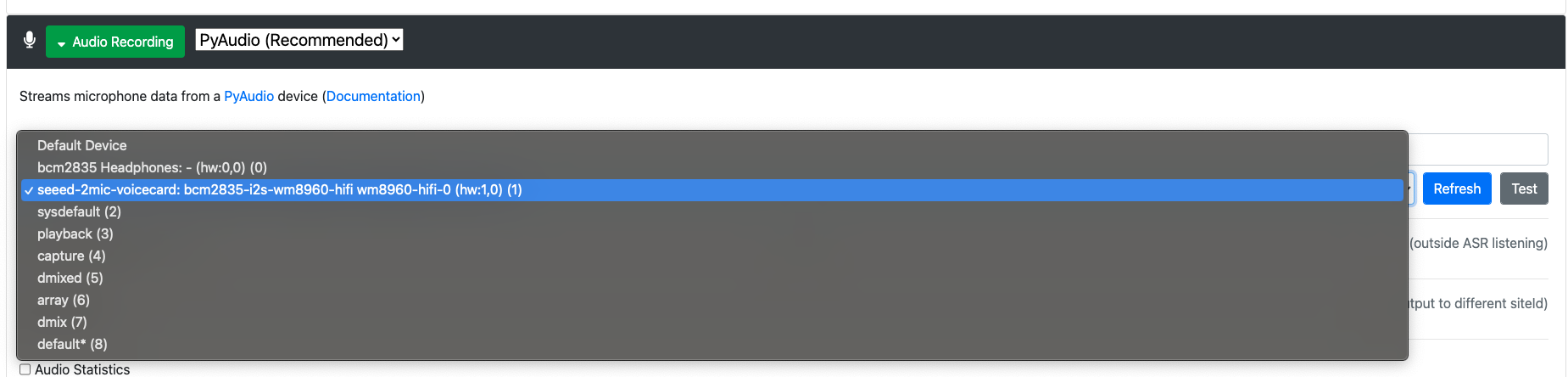
At a quick read it looks as though that should work … but leaves me with a few questions.
Which tutorial did you follow ? This one ? Otherwise please post a link to it.
When I set mine up, the .IMG file on seeed website was already over 4 years old, and so I did not use it. It looks as though someone has updated the image to “buster” version (2021), so it should be usable.
When i was setting up my own Rhasspy satellites I had similar problem and so made a point in my tutorial of testing the audio input and output with arecord and aplay. No point carrying on until you know the hardware works.
Note that “arecord -l” lists only the currently selected recording device, whereas “arecord -L” lists all the available devices. When you did the arecord/aplay of
arecord -D "plughw:2,0" -f S16_LE -r 16000 -d 5 -t wav test.wav
aplay -D "plughw:2,0" test.wav
did you speak and hear your speech ? If not, you will have to get this working first. Maybe “plughw:2,0” is not the correct device.
I don’t recall installing libopenblas-base or having to do a --fix-broken install … so I’m wondering if there was a problem here. Is rhasspy_armhf.deb the correct version for RasPi 4 (my RasPi Zero and RasPi 3A used different packages files) ?
Both my current Rhasspy satellites use arecord for Audio recording … though I remember being surprised a while back to discover that one was using a pyAudio … so it may not make a difference.
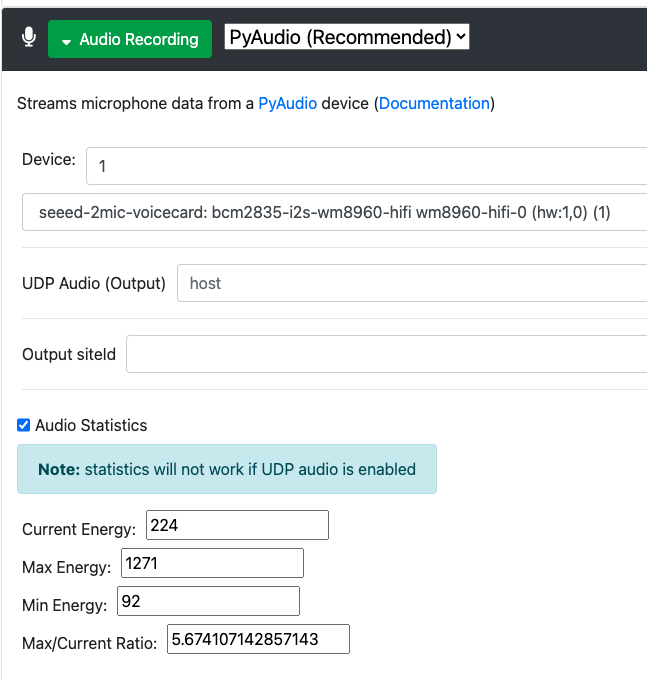
If you are seeing the figures under “Audio Statistics” change with sound in the room, then Rhasspy is detecting sound.
The “Wake up” pop-up should time out after a minute or so. This suggests that there is a problem … and probably an error message somewhere.
yeah … NO ! Error messages always indicate a problem, especially when we don’t understand what the message means.
Tell us the error messages, and when and where they occur.
I understand that you’re frustrated … it took me 3 attempts over 12 months before I got Home Assistant running, and Rhasspy was almost as many learning curves. The official rhasspy documentation is better than a lot of FOSS projects - but still still noticably “notes by the developer for other developers”. User documentation is a whole different kettle of fish.
Google and Amazon provide ready plug and play devices. They even have a lot of support in Home Assistant.