KWS small lean and just enough for fit for purpose

@fastjack

Also deepspeech KWS is single threaded and on a Pi3 runs at less than x.5 real-time.

However as an authoritive server KWS it might be very useful, but yeah KWS availability, accuracy and process load doesn’t give much to choose from.
There are KWS available and the deepspeech eventually will be released so its actually interesting as this allows some flexibility towards accuracy as being lite-weight is also a big concern and in many satellite situations a server can also be an authoritative KWS and override lower tier error.

I am back on about what I have posted before.

https://blog.aspiresys.pl/technology/building-jarvis-nlp-hot-word-detection/

That much is already there but playing with the simpler.

That model creation is actually quite easy as in the tensorflow example its done on 1 line of an input parser.

I don’t know if its intentional but the tensorflow example is extremely stinky in its choice and creation of spectograms whilst maybe its intentional it omits a line and lib call to librosa.
As the Aspiresys.pl blog states.

def extract_audio_features(self):
    audio, sample_rate = librosa.load(self.file_path, sr=self.sample_rate, res_type='kaiser_best')
    self.mfcc = librosa.feature.mfcc(y=audio, sr=sample_rate, n_mfcc=40)
    self.mfccScaled = np.mean(self.mfcc.T, axis=0)

There is only a little bit more as spectograms don’t do well with noise but at the creation of an mfcc you can raise the log-mel-amplitudes to a suitable power (around 2 or 3) before taking the DCT and this is something I was thinking would have to happen as an audio expander filter but actually it can be done there.

So code wise we already have the source it just needs patching together and then its back to that single line of model creation.
default='yes,no,up,down,left,right,on,off,stop,go',

Models are often far too literate there is basically the keyword and further classification is to split and provide phonetic start and syllable count that have huge input into a mfcc spectogram as you can deduce as much to its match with other classifications as with the keyword itself.

Then we keep mentioning its about the quality of the models and how we lack them but actually in terms of dataset now there is not really a shortage and that is all that models contain.

How you capture audio sets a window and that is pretty consistent and with the audio tools we have available it is possible to recreate the same window around data-set items for use.

Its all here and its not all programming as there is quite a bit of ‘filing’ to be done, but also because of the current situation and lack of options all we need is something that is fit for purpose.

I have only got a GTX780 but a model only takes a few hours, in fact I have another on the way as planning on knocking out a few models and sharing results.
But it does take hours and there will probably be quite a few models but its not that a huge undertaking if shared by a few.
We just need to set some presentation standards in labels used, accuracy and classification sensitivity and I have a hunch we might get the start of a model that can be fit for purpose but also a great demonstration of much of what is involved as this is just KWS and thankfully I don’t have to think about ASR.

2 Likes

Have you ever used Google colab?

That is a cloud service and not sure what that has to do with anything?
It sort of goes against why I want a private AI and prob also many others.

As far as I’ve understood you’re building a ml model with your graphic cards. In case it’s not fast enough it’s maybe worth a try. I’m using a lot google colab to work with nlp models at uni atm due to covid.

Sure it’s not that private using this. Has just been an idea. No offense

Apols Bozor actually I agree with you but its called Cloud TPU but the Colab is an actual service that as far as I am aware it really sucks you into using google services and Apis.

If it just comes to booking per hour tensor flow yeah no prob with that.
Not up for long and obvs haven’t woke up yet.

Its actually about sharing load as say the mozzila common voice its organisiation is awfull and we should be putting these datasets into accessable databases as the content they hold is immense.
I downloaded the 42gb tar of common voice and there is so much in a single folder it just kills my 16gb I7.

Maybe colab as get where you where coming from now, but even thinking some openspace to share.
It just needs simple agreement to do so and nothing more and some webspace.

If we get it then I can start using a database to provide queries on dataset selection but the actual couple of hours to run a model that your testing isn’t that bad.
Its a couple of hours with a single GPU and will have to relatively low cost ones and prob over an hour maybe 2.
For many they can run a model and the go alien kicking or whatever in a game of choice afterwards. :slight_smile:
I picked a GTX780 as its a a relatively low cost reasonabilly modern card for $60-80 but guess many will have more than that available already.
The hindrance isn’t running the model its creating models on data that differs from the capture you feed it.
That is extremely concentric to the project and not just ‘black box’ sharing of completed models.

What we should be doing is windowing the datasets so they match our method of capture.
Then many can share and run models or use TPU cloud access if they wish.

If you look at the wav capture and gap spacing then often they change in normalised volume gap spacing and wav centering.
Oftens its 16000Hz S16LE 1 channel.
But the capture routines such as HermesAudio should also be able to parameterise dataset entries.

PS apols as duno why but completely got the wrong endof the stick but actually we don’t need to enforce collaboration but the common data we have could really do with being in a better format than it is.

The VAD & Sox processing we use leave a distinct signature on capture that should be the same on the dataset.

Originally I thought ‘keyword’ / ‘not keyword’ would be the best way to classify and if you apply only a single ‘wanted-word’ in the above that is what you will get.
‘Keyword’, ‘Unknown’ & ‘Silence’.

I have been more interested in the ‘Unknown’ classification in that it hardly ever changes substantially and leaves results based purely on recognition score which also has limited change to new recorded wavs of keyword.
The latter is the recording window and presentation of our dataset is often very similar in the dataset but not to the new recorded recognition keywords.
Its a pretty easy fix as the datasets we have need to be preprocessed with the audio capture tools we use.

This is what I am getting onto as a project as there is a complete lack of audio_processing tools for recognition and its just purely a blackbox of a coding exercise of python skills rather than the project of a Voice AI that it supposedly is.

That there isn’t an iniative or work in providing a Rhasspy dataset speaks volumes in the reality of what is here.

With a project you have set audio_processing capture and you know the exact methods and paramters so you can massively increase accuracy by creating a dataset that has been processed by the projects methods.
It will never be like a general purpose commercial KWS that copes with all form of input, but it doesn’t have to be because this is for Rhasspy.
You can quite easily match commercial KWS recognition levels be simply processing the dataset to your audio processors of the project.

The only other thing is what is unknown as there is no such thing with voice as its purely a collection of phonetic and sylable count or at least to a large extant that is all a MFCC spectoram is.
In English there are only 6 base phonetics.

Its not something we need to work out as that is already done and documeneted, I have to admit I don’t get the Glottal collumn as in English it would seem more of a 7th row, but hey :slight_smile:

The starting consonant and sylable count, paints an extremely strong picture in a spectogram that with consonants there is no such thing as unknown.
Sylables often don’t go past 3 sure there are 4 but struggling to think of one but if there are only 6 consonants I might argue there are 7 that is still only 18 - 21 classifications.
With 4 sylables then that is 24 - 28 dpending on how many consonants exist.

Using ‘Unknown’ to provide weight is absolutely pointless but just like google page rank the weight of the returned page is more than just word occurance and click count and its weight is modified by the proximity of surrounding classification.

That isn’t rocket science and niether is a KWS specific to a project with specific audio processors.
Its extremely likely it could be done just isn’t, isn’t even an attempt.

Programming and creating audio processors without the extensions to manipulate datasets is a huge ommision from the project.

Hey @rolyan_trauts!

I’ve been trying to train a CNN model (using Tensorflow.js) for both KWS and speaker identification (as I think this is the easier way to get both :wink: ) but without success.

I think my dataset is too small to achieve a good enough accuracy. I’ve augmented it with added noise, normalization, tempo changes, etc.) but I cannot get the trained model to detect my keyword correctly.

Did you succeed to build a KWS model that at work (even poorly)?

Yeah but it will always work poorly as the dataset wav have an extremely common recorded format that when presented with new or via rhasspy it wll lower the recognition score.
You can test by using a model wav vs one recorded yourself.

Even with the terrible spectograms of the tensorflow speech-command example I get +.85/+.65 recognition of model wav / recorded wav repesctive.
The spectograms created in that example are pretty stinky but what is even more stinky is the difference between dataset wavs and use wavs.

Really they need to all be fed through the rhasspy audio processing and then collated into a dataset otherwise it will always be bad.
But just off the bat the KWS example in the tensorflow github works extremely well with the model wavs but not as well with new recordings.

Wav (left) from model
left (score = 0.98248)
yes (score = 0.01425)
unknown (score = 0.00211)

Wav (left) not from model
left (score = 0.64037)
right (score = 0.26301)
unknown (score = 0.07466)

Just doing what the tutorial says vanilla with stinky spectograms and no audio processing of dataset.

    python3 tensorflow/examples/speech_commands/freeze.py \
    --start_checkpoint=/tmp/speech_commands_train/conv.ckpt-18000 \
    --output_file=/tmp/my_frozen_graph.pb

python3 tensorflow/examples/speech_commands/label_wav.py \
--graph=/tmp/my_frozen_graph.pb \
--labels=/tmp/speech_commands_train/conv_labels.txt \
--wav=/tmp/speech_dataset/left/0a2b400e_nohash_0.wav

PS the image data is MFCC but dunno why they just look really low res and not detailed enough to other forms I have seen.
The above with that works ok with a single sylable word but should be even better with multi sylable of the audio concatenation of ‘hey rhasspy’ as a MFCC or similar key words.
I do think lumping many together into ‘unknown’ is a bad idea as then it creates this unknown classification that is a blur of such variance that its little use.
I have a hunch you could do this by phonetics and sylable count and use the complete return parameters of multiple categories to apply weight to the keyword score that might not be an obvious standalone score :-
Wav (left) from model
left (score = 0.98248)
yes (score = 0.01425)
unknown (score = 0.00211)

The use of phonetics again can make things more accurate but aso narrow scope as in terms of dialect here we have Received Pronunciation or RP (TV English).

https://www.englishclub.com/pronunciation/phonemic-chart.htm

But based on how you label your data and classify your data you probably make it more accurate by the weights of other classifications.
Maybe even I have got it the wrong way round about the MFCC images and theres is too much resolution that creates difference.
Probably raising the log-mel-amplitudes to a suitable power (around 2 or 3) before taking the DCT would help with pattern matching but I am groaning when looking at the code.
I suppose in models.py its easy enough but my python is pretty shoddy but wondering if its as good as librosa but its certainly not as easy to read.

python3 tensorflow/examples/speech_commands/train.py --data_url '' --data_dir $HOME/speech-commands/speech_dataset --wanted_words "visual" --testing_percentage 30 --unknown_percentage 30

The dataset now has all wav files in subfolders of visual, OneSylable & TwoSylable.
‘visual’ was chosen because it was the only 3 sylable word, no phonetics have been used just a split of the remaing into one or two sylable and the testing & unknown percentage has been upped to 30%.

INFO:tensorflow:Step #400: rate 0.001000, accuracy 97.0%, cross entropy 0.072042
I0516 14:37:50.033674 140668330936128 train.py:260] Step #400: rate 0.001000, accuracy 97.0%, cross entropy 0.072042
INFO:tensorflow:Confusion Matrix:
 [[  8   0   6]
 [  0   0   0]
 [  2   0 137]]
I0516 14:37:51.808054 140668330936128 train.py:287] Confusion Matrix:
 [[  8   0   6]
 [  0   0   0]
 [  2   0 137]]
INFO:tensorflow:Step 400: Validation accuracy = 94.8% (N=153)
I0516 14:37:51.808295 140668330936128 train.py:288] Step 400: Validation accuracy = 94.8% (N=153)
INFO:tensorflow:Saving to "/tmp/speech_commands_train/conv.ckpt-400"
I0516 14:37:51.808451 140668330936128 train.py:296] Saving to "/tmp/speech_commands_train/conv.ckpt-400"

Classifying by the construction of the the words provides far more correlation to the mfcc spectogram so instantly the model accuracy is high.
The 3 sylable ‘visual’ is extremely unique and is akin to ‘heygoogle’ ‘alexa’ keywords that are also chosen for sylable complexity and phonetic uniqueness.

I will let that run and see how the end tests are.
The dataset was moved 2 new folders added (OneSylable, TwoSylable) then all word folders moved to the corresponding folder.
The testing percentage has been upped and this is going to take much longer and generally the Google command set is specific for commands and prob not the best collection for KWS but the default demo only used 10% of what was available which is limited anyway.

I think this is how Snips trained their « Hey Snips » model. They trained a model to recognize « unknown », « Hey », « Sni » and « ps » sounds and used a specific post processing algorithm to check if the correct succession of sound was detected.

I have no knowledge of Snips but just been looking and researching what a MFCC image looks like as an image.
So first the sound and construction of words is the only logical structure for a time based image of words that MFCC creates.
But yeah I think you can classifiy with high accuracy and then post process against those classifications in a sort of reverse google page-rank to provide further weight to recognition.

I think Mycroft Precise is a phonetic splitting engine so you can create your own combinations but that increases load and reduces acuracy.
I have noticed with Precise that at times it will recognise ‘Mycroft’ without a ‘Hey’ as KW even though it shouldn’t.
I think that is for most parts why Porcupine is so fast and light as its a single word trained model and not some postprocessing system of concatenated phonetics.
Doesn’t matter if as literal language ‘heysnips’ is two words as a model word its a single 2 sylable word if trained as porcupine models.
Splitting into single words and then concatenation processing just requires heavier models and postprcessing complexity.

I am going to run this which will be just ‘visual’ vs ‘unknown’ then run with ‘visual’, ‘OneSylable’, ‘TwoSylable’ as wanted to see even though distinct the blur of all in unknown creates a none descript and essentually useless datum for postprocessing which is just a score alg aka page-rank.

Then also if you are going to phonetic split to how many classifications and how much data you need.
The common voice, Librevox, VoxCeleb and google command set all have the wavs in there datasets but extracting into words that are more applicable to give even coverage in classification quota whilst maintaining fast and small models is all a leap in the dark to me.
Also in this example the MFCC format has me totally bemused as bin_count for mfcc is 40?! Whats that then!? :slight_smile:

Also the trick to reduce background noise of raising the log-mel-amplitudes to a suitable power (around 2 or 3) before taking the DCT.
Not really sure where to do that in this code but many advocate its use as basically its a bit like an audio expander where the predominant features are accentuated and what are likely artifacts tend to drop out of the MFCC image.

Rhasspy could definately have its own KWS but to stop its models being a black box we need to share and have some form of queryable dataset that is just taken from the huge collections that are freely availablle but based on word construction and sound rather than literal meaning.

Also you can overtrain models as not sure what really happens but accuracy seems to have this epoch target and then going past that things seem to degrade.
I hit 100%/100% training and valdation accuracy after a couple of 1000 steps and now seem to be making things worse but will just let it run purely so its like for like and maybe readup on that another time.
Keras seems to have this function to cut short training on best hit accuracy step, with the google example you use Tensorboard and monitor and set that yourself.
Seems once you hit a level training from that point has no gain and can even add error to the model.
Prob about 8000 pointless steps done on this very simple model.
I think you can load up any checkpoint and start again or process that step --start_checkpoint

1 Like

visual (score = 1.00000)
unknown (score = 0.00000)
silence (score = 0.00000)

With a trained wav couldn’t be more certain.

Same with my voice as this is with various volume levels

visual (score = 0.92848)
silence (score = 0.07152)
unknown (score = 0.00000)

But if it had audio processing and normalisation the test on 5 recordings is 100%

@fastjack

Its a bit of a pain in the proverbial as it grabs labels from the bottom folder name and copying the files is a problem as even though looks like a uid or hash or somethig there are many duplicates
Prob tomoz but think its demonstrated how accurate a CNN can be if you categorize by mfcc sound image rather than literal words.

The model is here and some capture clips after the model was created.
Using visual as it was there but the clips show how the capture window must be the same as the model window and that KWS is extremely easy and accurate but the dataset wavs must be preprocessed by the project audio_processor otherwise you are just adding inaccuracy.
You have to have accurate capture windows in your dataset otherwise the accuracy for word simularity will suffer or like the majors you select and fix with unique non similar KW choice.

There are always going to be words that are extremely similar visable/visual but also regions are not just country and generally an assumption of ‘Capital’ pronounced recievership of a nation.
Models are really easy to create the datasets are really accessable and we have a Voice.AI project that doesn’t process its own datasets.

The models and labels are in speech_commands_train.zip.

Model can be run, just edit the folder/file names.

python tensorflow/examples/speech_commands/label_wav.py \
--graph=/tmp/my_frozen_graph.pb \
--labels=/tmp/speech_commands_train/conv_labels.txt \
--wav=/tmp/speech_dataset/left/a5d485dc_nohash_0.wav

From the tensorflow repo

Its not about the models for a singular KWS as that is no advantage for opensource or a primary function of sharing models.
Sharing a dataset for a project is hugely important as if that is done the models wil come.
Strangely that is not done or even talked about.
Its not really opensource when your datasets are closed as in terms of models that is the code.

1 Like

PS there are some brilliant resources on https://openslr.org/83/

That one for me being English is important as it is split regionally and by gender.
Being a Northern Oink! http://www.openslr.org/resources/83/northern_english_male.zip is likely to produce much better results but the words are in sentances but there are many.
But its not just being English as regional dialect can have huge effect on accuracy in all languages.

Is there any of you python guru’s who can run ASR and mark audio with cut points on recogintion and split wav sentances into words.
It doesn’t matter so much about words that can not be split as generally the datasets are extensive and presuming numerous word sets could be gathered.

It would be great to have a database that you just run a query and get a dataset or datasets based on region, word, sylable, phonetics, pronounciation, language…
Getting the space and setting it up could be a huge task and would stilll benefit from a word extraction tool as many datasets are sentences.

If you are only armed with Audacity organising a dataset for a model is hugely intensive, but some tools to normalise, set wav window parameters, rate and encoding are probably not much to code and does anyone know if anything already exists?

PS another model there which was just the interest of how a keyword relates to what its not so had the additional labels of onesylable & twosylable with corresponding word collections.
Testing with my audio_capture from above the simple cnn as long as normalised manages to differentiate similar words such as visible and mythical extremely well.
Also when normalised can tell the are 2 sylable words and not sure if they will be used but it does seem to make the keyword detection more accurate.

I’m using Sox for audio data augmentation like normalization, adding noise, tempo changes, etc.

It is quite easy to use and pretty powerful.

Yeah its ok for taking out silence and stuff and a great toolkit.

Its the ASR to create split points in audio so that something like sox could.
Most datasets are spoken sentences that we have the text but not split cue points.

If you take the google command set there are 3000 for each word and don’t fancy doing that manually via audacity.
The datasets also allow to to queue up sentances that you know conatin words but even with sox without those split cue timings its a no go.
Unless you got ideas how?

Deepspeech I love you!

deepspeech --json --model deepspeech-0.7.0-models.pbmm --scorer deepspeech-0.7.0-models.scorer --audio audio/2830-3980-0043.wav
Loading model from file deepspeech-0.7.0-models.pbmm
TensorFlow: v1.15.0-24-gceb46aa
DeepSpeech: v0.7.1-0-g2e9c281
Loaded model in 0.00822s.
Loading scorer from files deepspeech-0.7.0-models.scorer
Loaded scorer in 0.000137s.
Running inference.
{
  "transcripts": [
    {
      "confidence": -24.236307801812146,
      "words": [
        {
          "word": "experience",
          "start_time ": 0.66,
          "duration": 0.36
        },
        {
          "word": "proves",
          "start_time ": 1.06,
          "duration": 0.32
        },
        {
          "word": "this",
          "start_time ": 1.42,
          "duration": 0.16
        }
      ]
    },
    {
      "confidence": -34.029636880447235,
      "words": [
        {
          "word": "experience",
          "start_time ": 0.66,
          "duration": 0.36
        },
        {
          "word": "proves",
          "start_time ": 1.06,
          "duration": 0.32
        },
        {
          "word": "his",
          "start_time ": 1.42,
          "duration": 0.16
        }
      ]
    },
    {
      "confidence": -35.76723024350955,
      "words": [
        {
          "word": "experienced",
          "start_time ": 0.66,
          "duration": 0.4
        },
        {
          "word": "proves",
          "start_time ": 1.1,
          "duration": 0.3
        },
        {
          "word": "this",
          "start_time ": 1.44,
          "duration": 0.18
        }
      ]
    }
  ]
}
Inference took 0.879s for 1.975s audio file.

Still need delete or omit the words deepspeech gets wrong as been wondering if proffessor floyd had a chip on his shoulder.
“Professor Floyd pointed out that mass lesions are a possible cause for epileptic seizures”
recognised as
"
{
“transcripts”: [
{
“confidence”: -100.5955242491676,
“words”: [
{
“word”: “professor”,
"start_time ": 1.3,
“duration”: 0.38
},
{
“word”: “floyd”,
"start_time ": 1.72,
“duration”: 0.4
},
{
“word”: “pointed”,
"start_time ": 2.14,
“duration”: 0.36
},
{
“word”: “out”,
"start_time ": 2.52,
“duration”: 0.14
},
{
“word”: “that”,
"start_time ": 2.68,
“duration”: 0.16
},
{
“word”: “malaysians”,
"start_time ": 2.92,
“duration”: 0.92
},
{
“word”: “are”,
"start_time ": 3.9,
“duration”: 0.08
},
{
“word”: “a”,
"start_time ": 4.0,
“duration”: 0.1
},
{
“word”: “possible”,
"start_time ": 4.14,
“duration”: 0.38
},
{
“word”: “cause”,
"start_time ": 4.66,
“duration”: 0.36
},
{
“word”: “for”,
"start_time ": 5.06,
“duration”: 0.08
},
{
“word”: “epileptic”,
"start_time ": 5.18,
“duration”: 0.58
},
{
“word”: “seizures”,
"start_time ": 5.92,
“duration”: 0.4
}
]
}
]
}

Its dangerous stuff this recognition lark! :slight_smile:

I’ve stumbled upon an article detailing how Snips handled the “personal” wake word detection with only a few samples:

This was a pretty interesting read…

@synesthesiam Maybe something similar could be implemented as a Rhasspy service? It should allow both custom wake word detection and speaker identification…

1 Like

I thnk you can do both now @fastjack

To be honest to to the availbility of technology and what @Bozor said the private services of creating models or hiring TPU slots is getting extremely cheap.
I think you can create a general large model and also custom training to that large general model that will be processed on a cloud server in minutes rather than hours on a I7 and forget about it levels on a Pi.

You might even be able to squeeze quite a few models in a single hour and if so the service becomes extremely cheap.
Offer the service on minimum donation as the training update needs to be done only once and maybe occasional updates and even opensource has to cover its running costs.
If it was $5 a pop it would prob also leave some additional funding even though small for storing datasets.
Models are blackboxes and not opensource as without the coding dataset they are closed so its essential to have the datasets.

But yeah you could prob also train just a simple specific KWS but also with the advent of cloud TPU you can train general large datasets and supplement with custom training.

They actually need to have set keywords and the use of phonetic based KWS that introduces high complexity, load and model is such a strange avenue to take.
Do you call a dog a cat because you prefer that word?

That article is great and the only thing I noticed and maybe you can do both but think this will create less load.
You don’t need to do audio preemphasis as you can do that via the MFCC creation by raising the log-mel-amplitudes to a suitable power (around 2 or 3) before taking the DCT.
High pass filetering is not all that load intensive but the above is also another solution to removing noise.
In fact you don’t have to do any of that but just import librosa and set the parameters but the action is the same.

That article is really good though and really do think there should be a truly open KWS that has access to datasets as sharing models is akin to closed source.

The false alarm rate of the Snips method is really high though False Alarm rate per Hour is 2.06

When say you compare to Porcupine that has 0.09 FApH

Things have moved very quickly in the AI world and that article when published was pretty cutting edge but aslo some of its content is now quite dated.
Its false alarm rate is extremely dated by many standards now.

But generally KWS is quite simple much of what is in the article is already in libs or frameworks or both.
ASR is complex KWS is fairly easy to accomplish but also the ability to use server farms in cheap slots has change on how we may use AI.
Custom training of use may well become a norm as over all other methods it can drastically increase accuracy.

But going back to datasets as its all about the dataset as any model created with a dataset that was captured with the audio capture system of use will always be more accurate.

The problems I have with Porcupine are:

  • it does not work well for languages other than English
  • a user cannot train a custom wakeword for Raspberry Pis (only Linux, MacOS and Windows)
  • it is not open source and I do not like the way Picovoice is heading toward commercial licenses (Snips much?)

The problem with training a NN is that for most people (I included) it might be way too complicated.

Snowboy seems to work pretty good with personal models based on a few samples (which might be based on the same DTW stuff as Snips) so I’d like to explore and see if this approach can work without taking out the big guns and train a NN using à multiple GBs dataset.

I’m very curious of the performance of the DTW technique though (accuracy and CPU wise).

I first though that ASR and NLU would be the hardest part but it turns out wake words seems be the most lacking one :blush:

Did you manage to get your « visual » model to run on a Pi on an audio stream without eating all the CPU?

To be honest I am not advocating all to train NN even if it is much easier than I expected.
You have seen my reluctance to code nowadays :slight_smile:

I haven’t actually tried the model on the Pi but reason I picked it is because of the extremely light CNN tensorflow KWS that have available examples proven and available.
Arm and a few others did some repos of fitting KWS into 22k was it? Anyway it runs on low end microcontrollers.


There is also mobilenet and various others but without trying I know pi3/4 it will tickle the cpu and on a Pi0 run not much different to Porcupine its all down to what you quantise to and export the model to.

This guy has some great Pi specific version with fixes and low load mobilenet examples and benchmarks and load can be extremely low.

I am exactly the same about Porcupine but the example you posted is > 2000% more inaccurate, that is not just bad that is utterly terrible.

I use Porcupine as a datum of low load high accuracy KWS but don’t advocate its use but actually believe similar results are possible.
KWS or NN isn’t hard and no-one is suggesting people train there own NN as that would make the assumption they have a reasonable > Cuda 3.5 compatible card and the patience.
Its very possible as part of an opensource offering a service that will do that and return in minutes without any knowledge of NN or training.
A general purpose KWS can run as is and be collecting KWS of an initial period and then the user can have the choice to upgrade with a custom train and needs no knowledge or equipment.

It wouldn’t be so bad if the snips method was 2-3x less accurate than some of the others but x22 worse is just extremely bad and that article was quite promising until my eyes bulged at that failure figure.

If you want accurate multipurpose KWS it takes GB of dataset training but the models it produces that people use are relatively tiny the ‘visual’ pb model is 1.5mb.

@ thinkbig1979 posted about Linto and had forgot about Linto as some of the server side operation put me off.

The KWS they have and the Python Lib https://github.com/linto-ai/pyrtstools is pretty excellent and would fill that gap Rhasspy has.

It even has a Hotword trainer App but once again its all about the dataset but Linto have wised up to this with.

https://wakemeup.linto.ai/

They also have a buster version with the seedviocecard driver installed.
https://gamma.linto.ai/downloads/Raspberry/v1.1/linto-maker-buster-v1.1-seeedvoicecard.img

The post got me looking at Linto again now I am not so noob about VoiceAI.

Looks really excellent and they give a choice of pre-created models or a model trainer app and also have datasets.

PS found another promising Pi KWS tensorflow repo.

Really good as if you check the above a series of tutorials and videos accompany it.

I have to say once more Linto is looking really good as everything I have been thinking of I keep finding Linto have already done it 6 months to a couple of years ago.

Started once more to find optimised mfcc libs for the Pi and this has cropped up quite a few times that no longer surprised to find exactly what I was looking for with linto.

I have no idea why those guys don’t have a community portal as it seems a crazy ommision?

They have also gone for a RNN model which I pressume is for reasons listed here.

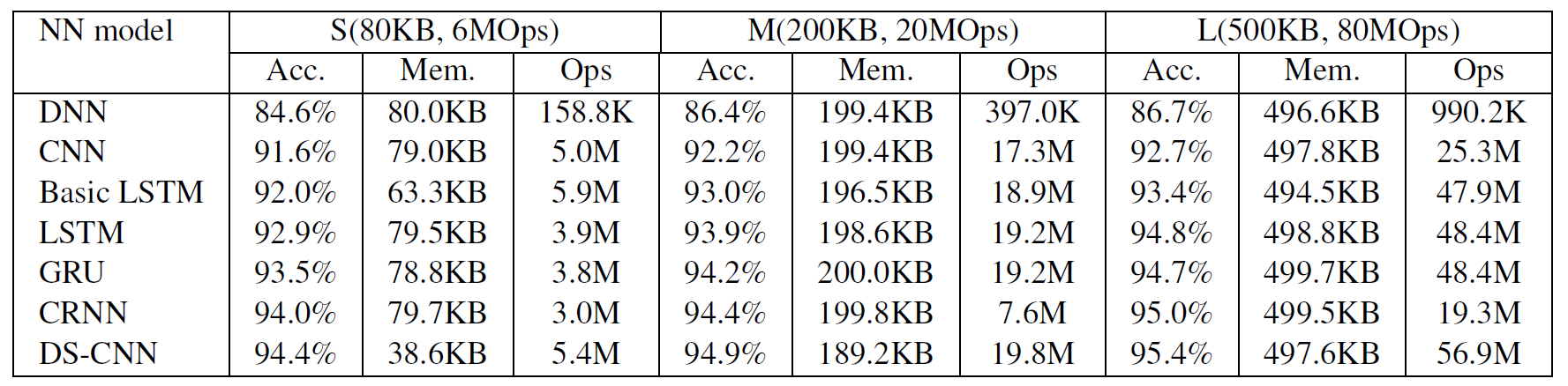
The DS-CNN model does provide the most accuracy but interms of Ops its actually the heaviest.
The CRNN is extremely lite and amlost as good so presuming why as DS-CNN would only seem prefereable in extremely low memory footprints hence why it was used for embedded.

Its probably quite easy to snatch the CRNN model creation from here and apply to the above tensorflow examples.

@fastjack Have a look at https://github.com/linto-ai/linto-desktoptools-hmg (Hotword Model generator)

Install on 18.04 in fact the binary they also offer makes it real easy but the inteface and setting for a Hotword Model Generator are near perefect with maybe just an evolution of further parameters to come.

Even if its not selected because of different KWS use the manner of the App makes a great template for any project to follow,
You can also just point and click to folders if they are a hotword or (not hotword) which makes the dataset side a little easier.

Its also has a test page and you can grab your mic and direct test the model you just made.
The speed of model creation is so fast compared to the tensorflow example I was running I am wondering how its done?

1 Like

The GUI looks pretty good! I’ll try to test it out as soon as I find enough time :+1:

1 Like

Even if not adopted that is very close to how a model builder app should be.
Maybe could do with some extra MFCC & parameter options but as is, is pretty much complete.

Out of curiosity, I implemented the personal wakeword system described by the Snips team in this post (in Node as I’m not a Python dev):

It is pretty easy to do (VAD -> MFCC -> DTW) and the accuracy is pretty decent. The CPU load is almost non existant (a few percents max on my computer, did not yet tried on a Pi or Pi0).

I can now not only detect a wakeword (interestingly even in noisy situations like a TV in the room) but the person who triggered it (speaker identification) as keyword templates are tuned to a specific voice.

The only downside is that every user needs to register its voice templates before being able to trigger the assistant.

I think it might be a really great addition to the Rhasspy wakeword family if one of the Python/C++ gurus out there is motivated (using C++ for the whole process - from audio frame to DTW cost - might be a good way of decreasing the load even more especially for the MFCC/DTW part).

Cheers :slight_smile: .

1 Like

Sounds really cool. Could you share your node code? is it somewhere on github?
Id be really interested to look at it :grinning:

Yep, here it is:

It is still a work in progress :wink:

3 Likes

Sounds interesting. To test your code I need recordings of me speaking the desired wake word? How many recordings are needed?

For VAD your code uses node-vad. If we want to create a C++ Version we would need a replacement for that. Are you using any other important modules?

I usually use 3 recordings for each keyword. The rules for the audio templates are the same as Snips (only trimmed wakeword with no noise, 16KHz 16bits mono little endian)

I’m using node-vad and a home made native node module named node-gist that provides bindings for the C++ Gist audio library for the MFCC features extraction.

All of this should be pretty straight forward to mix in a C++ library / binding for a seasoned C++ dev.

Note : I have my own recording script and did not try with mic but it should work as long as you pipe 16KHz 16bits mono buffers into the detector.

Talking about snips wakeword I use for two years now with three customs wakewords (one per family member here) and it works really great. And indeed in jeedom I can filter per person in a scenario.

Actually I have even better results with snowboy but didn’t really tried with multiple custom wakewords.

I’ve still not put rhasspy into production only due to this wakeword problem. All is running fine, Jeedom plugin works perfect, but not having a viable solution for multiple custom wakeword is a no brainer.

Let’s see if rhasspy can integrate this one ? Also as rhasspy interface ever have access to mic to test intents, would be awesome if we could create custom wakewords directly from the interface. My custom snowboy scripts are in python and have recording and detect noise, and cutting so it may help.

But rhasspy really need a viable solution for multiple custom wakewords ( without having to redo it every 30days …)

The thing that put me off the snips method was.

On voices, the False Alarm rate per Hour is 2.06, which means that with people constantly talking next to it, the wake word Detector will trigger about twice per hour with default settings. Improved performances can be obtained by tuning decision parameters on a case by case setting. The False Rejection rate is 0% without background noise, and 0.3% in noisy conditions.

Its sort of stretching reality to say that is good.

I don’t actually see training as a disadvantage and actually see it as a strong advantage and dismayed that not only here that the VoiceAi can not collaborate with something as simple as a dataset spreadsheet to create a central distributed dataset or even something more snazzy, but dismayed as providing word datasets is real easy and just not done.

VAD/SAD should not be a seperate process to MFCC creations as the very same FFT routines do the same thing whilst VAD works on stride or frame whilst MFCC is over a framing window.

There already exists a Julia Lib that alaready does this and much more.

https://github.com/JuliaDSP/MFCC.jl

But because we are often on a ARM platform a C implementation with Neon specific optimisation for https://projectne10.github.io/Ne10/ would be the ultimate sweet spot, as the gains can be quite large.

Then we just need some simple tools that run on Windows and Linux that work in a similar manner to the excellent https://github.com/linto-ai/linto-desktoptools-hmg/wiki/Training-a-model
That easily allows the addition of validated word dataset folders to create a model.
Allows you to visually set parameters on the VAD->MFCC process you wish to employ.

Why we don’t have a simple central spread sheet or dataset Urls is a complete mystery to me.
Also a central datasource of completed models that allows choice by Language, region, gender and age would allow those who don’t want to train a bespoke model.

The tools to enable this are quite simple and there is huge need and coding is a choice of whatever is easy to distribute, if it runs and is easy accessable the code of a UI doesn’t need much dictate.

I have my doubts about the accuracy of the Snips implementation but understand why Mathieu Poumeyrol might see that as a contender.